Friday, July 22, 2011

Has "multi-tasking" been over-rated?

I read an article a few months ago that mentioned the number of messages, or pieces of information we are bombarded with on a daily basis. The author was talking about how difficult it seems to have become to concentrate on any one thing for an extended period of time. Have you found that to be true?

We live in a multi-media age that seems to frame discussions into 'video clips' and 'sound bites'. In our individual lives, we take on a myriad of things to do, and it often seems that a lot of our energy is spent trying to re-focus our attention in order to get to the point where we can address the next pressing priority of the moment. I wonder if that time could have been better spent in actually addressing the issues themselves. In other words, our first problem is getting to the place where we can properly address the problem!

Has the perceived value of "multi-tasking" been over-rated? How many things can you really focus on and do well?  What does multi-tasking" mean to you? How have you balanced the various "in-boxes" on your desk?

Please share your thoughts with a COMMENT to this POST.

Monday, July 18, 2011

Asking, "Why" Five Times

Do you remember when you were younger ... how many people did you drive 'crazy' with that one simple question, "Why?"  But when it comes to making improvements in business, asking "Why" is a very good question to ask. In fact, you may have heard of "Asking Why Five Times" which I understand has it's roots with Toyota (speaking of driving)! 

Here is something on Toyota's philosophy of asking, "Why" Five Times.

We come across problems in all sorts of situations in life, but according to Taiichi Ohno, pioneer of the Toyota Production System in the 1950s, "Having no problems is the biggest problem of all."  Ohno saw a problem not as a negative, but in fact as "a kaizen* opportunity in disguise."  Whenever one cropped up, he used to encourage his staff to explore problems first-hand until their root causes were found. "Observe the production floor without preconceptions," he would advise.  "Ask ‘why’ five times about every matter."  Source:  http://www.toyota-global.com/company/toyota_traditions/quality/mar_apr_2006.html
* Kaizen : In Japanese, the definition of Kaizen is "improvement" and particularly, "Continuous Improvement"-- slow, incremental but constant.
Here is the example that Toyota uses to describe the application of "Asking Why 5 times":


  1. "Why did the robot stop?"
    The circuit has overloaded, causing a fuse to blow.


  2. "Why is the circuit overloaded?"
    There was insufficient lubrication on the bearings, so they locked up.


  3. "Why was there insufficient lubrication on the bearings?"
    The oil pump on the robot is not circulating sufficient oil.


  4. "Why is the pump not circulating sufficient oil?"
    The pump intake is clogged with metal shavings.


  5. "Why is the intake clogged with metal shavings?"
    Because there is no filter on the pump.

How could asking why 5 times help you get to the root cause of a problem that is keeping you from success?

Friday, July 01, 2011

Success - A Sense of Satisfaction

Every now and again I come across little pieces of information, stories or anecdotes that remind me that it is a wonderful thing to find satisfaction in what you do for a living. Perhaps you've seen statistics related to this and how a large percentage of the working population have an underlying sense of discontentment in the work that they do.

Perhaps you can add some additional stories to this section, but here's one about the mechanic and the surgeon that I located on the Internet at:
<http://www.businessballs.com/inspirational_motivational_quotes.htm#come_to_the_edge_inspirational_poem_quote>
   
A heart surgeon took his car to his local garage for a regular service, where he usually exchanged a little friendly banter with the owner, a skilled but not especially wealthy mechanic.

"So tell me," says the mechanic, "I've been wondering about what we both do for a living, and how much more you get paid than me ..."

"Yes?..." says the surgeon.

"Well look at this," says the mechanic, as he worked on a big complicated engine, "I check how it's running, open it up, fix the valves, and put it all back together so it works good as new... We basically do the same job don't we? And yet you are paid ten times what I am - how do you explain that?"

The surgeon thought for a moment, and smiling gently, replied,"Try it with the engine running..."

Saturday, June 25, 2011

Who's Helped You Reach Business Success?

When it comes to Business Success, I am reminded of the fact that success is rarely a solo endeavour. More often than not, there have been many people involved in the advancement of a business venture. While they may not always be seen in the ownership structure or on the payroll, the input, direction and efforts of many who are outside of the firm have often contributed significantly to the success of the venture.

So my question is: Who's helped you reach "Business Success"?

Keeping that thought in mind, the celebration of success is also very important. And what a wonderful time of celebration we had on the evening of Friday, June 24, 2011 as many gathered to honour Pat Klak, Executive Director at Leduc-Nisku Economic Development Authority. Retiring from this role, Pat has been a terrific role model, a tireless team builder and an outstanding leader in her community. In the midst of all of the accolades that evening, I lost count of how many times the word "Mentor" was mentioned in the various tributes. Mentorship has obviously been important in Pat's life and it has been very evident in her style of helping others to find success.

I was pleased to also reconnected with Grant McDowell, Lead Pastor at the Leduc Alliance Church. Grant has been actively involved in community development. Just a few months ago, Grant shared his unique perspectives on Mentorship with me, which can be seen on my YouTube Channel at http://www.youtube.com/user/ProvisionMentorship

Wednesday, June 08, 2011

Client Service, and Angry Clients

One of my favorite comments to share with business audiences is simply this: "Without a client, you don't have a business."  Think about it for a moment - where would we be without clients, customers, shoppers, members? Yet, how often do we fail to fully appreciate the importance of those who choose to purchase our products or services?

Clearly, one of the keys to business success is to have a strong client base that not only buys what you have to sell, but become strong advocates and supporters for your business.  

Now, while we would all love to always have "happy clients", that isn't always the case. Sometimes we have clients that are less than satisfied with some aspect of our business. Something went wrong, didn't work as described, wasn't delivered on time, arrived damaged, came in the wrong size or colour. There are many things that could be the source of potential client dissatisfaction.

I recently had an opportunity to share some ideas on how to deal with "Angry Clients".  Hopefully your experiences with angry clients will be few and far between, but when the time comes, I trust that these comments will be helpful to you.

Here are a couple of thoughts to start. Please feel free to add a few of your own ideas as comments to this post!

When dealing with an angry client, make the effort to be:

POLITE – Try to appreciate that the "angry client" is likely at that state, not because of you personally, but rather, they are more likely to be angry because of repeated frustrations that they have encountered. A combination of things have not gone the way they anticipated. It will be helpful to remember that causing further agitate for the client is not going to improve the situation. It will be important to listen to the client, recognize what they have experienced, reassure them that you want to help them find a solution, or next step (as may be appropriate). 

PATIENT – When working with an "angry client" it is important to exercise an extra measure of patience. Listen carefully and try to understand what the client has experienced. Find out what went wrong, look for the root causes, and put the wheels in motion to fix things to prevent similar situations from occurring in the future. (It's a part of the cycle of continuous learning and improvement.)

POSITIVE – While it may be tempting to argue with an "angry client", a more successful outcome is likely to be achieved through positioning yourself as someone who wants to help the client find a satisfactory solution. In a very real sense, we should be thankful that they have brought the problem to our attention. Take the approach that you and your client are on the same team -  that by working together, a better solution will be found for your clients, today, and well into the future!

Sunday, June 05, 2011

Secrets of entrepreneurial success ... What are they?

I was in Calgary awhile ago and had opportunity to speak with Richard Truscott - Director of Provincial Affairs at Canadian Federation of Independent Business (CFIB) following a presentation that he made to a business audience. The CFIB has done a great job of regularly seeking the opinions of their membership - currently, over 108,000 small business owners from coast-to-coast. With that kind of input, the CFIB has well represented the interests of the small business community to all three levels of government in Canada for the past 40 years.

In an April 2011 CFIB report, "Secrets of entrepreneurial success", by Nicole Troster, Research Analyst, you can discover some of the "keys to success" that every business owner should review.

In the opening comments, Troster writes:
"Ever wonder what makes entrepreneurs successful? Business owners attributed their success to employees, customer loyalty and just plain hard work. And in return, entrepreneurs help to build communities by giving back to the very people that support them."

Read more in the full report that can be seen at:
http://www.cfib-fcei.ca/cfib-documents/rr3223.pdf

Sunday, May 01, 2011

The CEO's Challenge - Moving the Business Forward

I love that little phrase: "It's amazing how much can be accomplished when we're not worried about who gets the credit!" How does a business, or an organization instil a sense of teamwork and collaboration, and yet provide appropriate recognition for the contributions that are made by the individuals within the group? The scenario applies to the world of business, but we likely see more evident of it in the world of sports! While a team may have many good players, every team has a few that are recognized as being the stars - extremely talented and gifted athletes. Yet, these are often the same people who openly acknowledge that their 'lights shine brightest' when they work in synch with their fellow teammates. They realize that the collective efforts of the entire team has contributed to their success.

Oh yes, there can be some real challenges when it comes to working together, and ultimately, that responsibility falls to the owners, who if not personally active within the business, appoint others into positions of leadership to act on their behalf. Somewhere in this mix is the Chief Executive Officer (CEO).

In doing some research on the role of the CEO, I came across a wonderful series of articles written by Stever Robbins, which I encourage you to read in full. Stever provides a number of great insights that will benefit anyone in a leadership role within a business or other type of organization that gets results through the efforts of other people. Please see the note and link provided at the end of this post. I've asked Stever for permission to quote him and appreciate his "teamwork" on this one! (Thanks Stever.)  

Admit it. We all feel a touch of awe when someone has it: the CEO title. The power, the salary, and the chance to Be The Boss. It’s worthy of awe!

Too bad so few CEOs are good at what they do. ... Many don’t know what their job should be, and few of those can pull it off well. The job is simple—very simple. But it’s not easy at all. What is a CEO’s job?

More than with any other job, the 
responsibilities of a CEO diverge from the duties and the measurement.

A CEO’s responsibilities: everything, especially in a startup. The CEO is responsible for the success or failure of the company. Operations, marketing, strategy, financing, creation of company culture, human resources, hiring, firing, compliance with safety regulations, sales, PR, etc.—it all falls on the CEO’s shoulders.

The CEO’s duties are what she actually 
does, the responsibilities she doesn’t delegate.  Some things can’t be delegated. Creating culture, building the senior management team, financing road shows, and, indeed, the delegation itself can be done only by the CEO.

Many start-up CEOs think fund-raising is their most important duty.  I disagree. Fund-raising is necessary, but the CEOs contribution is in building a superb business with the money raised.

What is the CEO’s main duty? Setting strategy and vision. The senior management team can help develop strategy. Investors can approve a business plan. But the CEO ultimately sets the direction. Which markets will the company enter? Against which competitors? With what product lines? How will the company differentiate itself? The CEO decides, sets budgets, forms partnerships, and hires a team to steer the company accordingly.

The CEO’s second duty is building culture. Work gets done through people, and people are profoundly affected by culture. A lousy place to work can drive away high performers.  After all, they have their pick of places to work. And a great place to work can attract and retain the very best.

Culture is built in dozens of ways, and the CEO sets the tone.  Her every action—or inaction—sends cultural messages ... Clothes send signals about how formal the workplace is. Who she talks to signals who is and isn’t important. How she treats mistakes (feedback or failure?)  sends signals about risk-taking. Who she fires, what she puts up with, and what she rewards shape the culture powerfully. [A great example is provided by Stever related to expressing or withholding appreciation for jobs that are well done, and the motivation or demotivate that may result.]

Team-building is the CEO’s #3 duty. The CEO hires, fires, and leads the senior management team.  They, in turn, hire, fire, and lead the rest of the organization.

The CEO must be able to hire 
and fire non-performers. She must resolve differences between senior team members, and keep them working together in a common direction. She sets direction by communicating the strategy and vision of where the company is going. Strategy sets a direction. With clear direction, the team can rally together and make it happen.

Don’t underestimate the power of setting direction. In 1991, at Intuit’s new employee orientation, CEO Scott Cook presented his vision of Intuit as the center of computerized personal finance.  Intuit had just 120 employees and one product. Ten years later, it’s a billion-dollar company with thousands of employees and dozens of products. Worldwide, it is the winner in personal finance, bar none. The success is due in no small part to every Intuit employee knowing and sharing the company’s vision and strategy.

If vision is 
where the company is going, values tell how the company gets there.  Values outline acceptable behavior. The CEO conveys values through actions and reactions to others. Slipping a ship schedule to meet quality levels sends a message of valuing quality. Not over-celebrating a team’s heroic recovery when they could have avoided a problem altogether sends a message about prevention versus damage control.  People take their cues about interpersonal values—trust, honesty, openness—from CEO’s actions as well.

Capital allocation is the CEO’s #4 duty. The CEO sets budgets within the firm. She funds projects which support the strategy, and ramps down projects which lose money or don’t support the strategy. She considers carefully the company’s major expenditures, and manages the firm’s capital.  If the company can’t use each dollar raised from investors to produce at least $1 of shareholder value, she decides when to return money to the investors. Some CEOs don’t consider themselves financial people, but at the end of the day, it is their decisions that determine the company’s financial fate.

This article was written by Stever Robbins, <http://www.SteverRobbins.com>  serial entrepreneur, productivity expert, adjunct lecturer at Babson College, and host of the top-10 iTunes podcast, The Get-it-Done Guy <http://www.getitdoneguy.com> . You can find more of his work at http://www.SteverRobbins.com.

For the balance of this article and much more related to the role of the CEO, go to: http://www.steverrobbins.com/articles/ceojob#part1

Sunday, April 10, 2011

Vision, MIssion and Values ...

How much thought should the business owner give to developing their vision, mission, and values? We had some great discussion around that subject with the group that participated in the 2011 BUSINESS START-UP SEMINAR SERIES, "Building the Basics of Your Business" - hosted by the Sherwood Park and District Chamber of Commerce and Strathcona County Economic Development and Tourism.

An interesting statistic was brought out by Tyler Westover, Small Business and Tourism Specialist with Strathcona County:  
● 71% of people surveyed said that they, “make it a point to buy brands from companies whose values are similar to my own.” (Source: Young & Rubicam, August 2010.)
 Sourced from Trendwatching.com - March/April briefing.

With that thought in mind, trying to find a way to connect what you the owner value, with the things that are valued by your target audience can make a huge difference in your potential business success.

As presented to the audience that gathered, your business can be 'the canvas' upon which you paint a masterpiece for the world to view. When they look at your business, what is the picture that they will see? Does it accurately reflect the image that you want them to have of you, and what you value?


WHAT ARE YOUR THOUGHTS and COMMENTS?


Saturday, April 02, 2011

Business Plans ... Do they help?

One of the things that I've found very helpful for people in business or going into business is to develop a business plan. The challenge is to overcome the temptation of saying to yourself, "I really don't need a business plan."  There are in fact, several very good reasons that you should have one, as I recently explained to a group of potential entrepreneurs in Sherwood Park, located just east of Edmonton, Alberta.  

This spring, I was very pleased to again facilitate the BUSINESS START-UP SERIES that was hosted by Strathcona County Economic Development and Tourism, and the Sherwood Park and District Chamber of Commerce. While some of the attendees were already 'up and running' most were still in the early stages of setting up their businesses.  Attendees were all eager to gather insights and information from the experts participating and appreciated the valuable learning that took place, with the generous support of the series sponsors: RBC Financial and Servus Credit Union.

For more information on "Business Plans" and a look at my video clip talking about it's importance, visit: http://www.youtube.com/watch?v=YgJmkqNwD5g


Tuesday, March 01, 2011

Shifting the Culture within an Organization

How do you create, or in the case of an existing business, shift the CULTURE within an organization?


Please share some of your secrets, because (as I'm sure you've noticed) this can be a huge challenge! 


1) Here is an exercise that I sometimes have people consider when I speak with audiences of potential entrepreneurs. This can also be adapted for audiences comprised of existing business owners as well. Simply, step back from the busyness of your current activities and allow yourself for a few moments to focus on your business from the perspective of planning to set it up.  Of course, this is easier to do if you haven't actually started the business! However, for those who are already up and running, use your imagination to take you back to that point in time just prior to starting the business.  


Now, think of your business as being a 'blank canvas' onto which you have the opportunity to paint a picture, any picture of your choice. Ask yourself the following questions: "What picture will you paint on that canvas? What is the image that will be portrayed to the outside world? What impression will others have of your business, and by extension, of you, its owner? What picture they will see?"


I believe that it is easier to shape the culture of your organization if you plan in advance, deciding what you want that culture to be. Change is challenging for most people to make. We tend to get comfortable with the way that things are, the status-quo. Even when we know that a proposed change will be beneficial, we tend to resist change. (File that under 'Strange, but true'.)


2) Related to this, I recently spoke with John Kuypersauthor of the newly published, Who’s the Driver Anyway? Making the Shift To A Collaborative Team Culture. John is a collaborative leadership and productivity expert, and he kindly sent me a wealth of information. (Thanks John)


What you see below is a portion of John Kuyper's article called, 
How to Shift the Sales Culture in Your Company

After describing his experience in attempting to shift the sales culture in a business where he was the VP of Sales, John said it was akin to catching a tiger by the tail, John writes: 

"What I wish I knew then was a concept called Time Frame.  It explains the role of each level in the organization.  I adapted it from the work of Elliott Jaques of Requisite Organization fame.   Time frame helps everyone get that this is the way successful organizations function, and what it means for each level’s role in building a high-functioning team.  ...   Today, leaders need to engage employees and that means teaching everyone what it means to work together as a collaborative team within a hierarchical structure.  Leaders at all levels need to know how to shift and share decision-making power up and down the organization.  It is a skill and any leader who manages people needs to learn it or face severe consequences in the 21st century ...  Command and control is dying and collaboration is the new leadership style."


Saturday, February 05, 2011

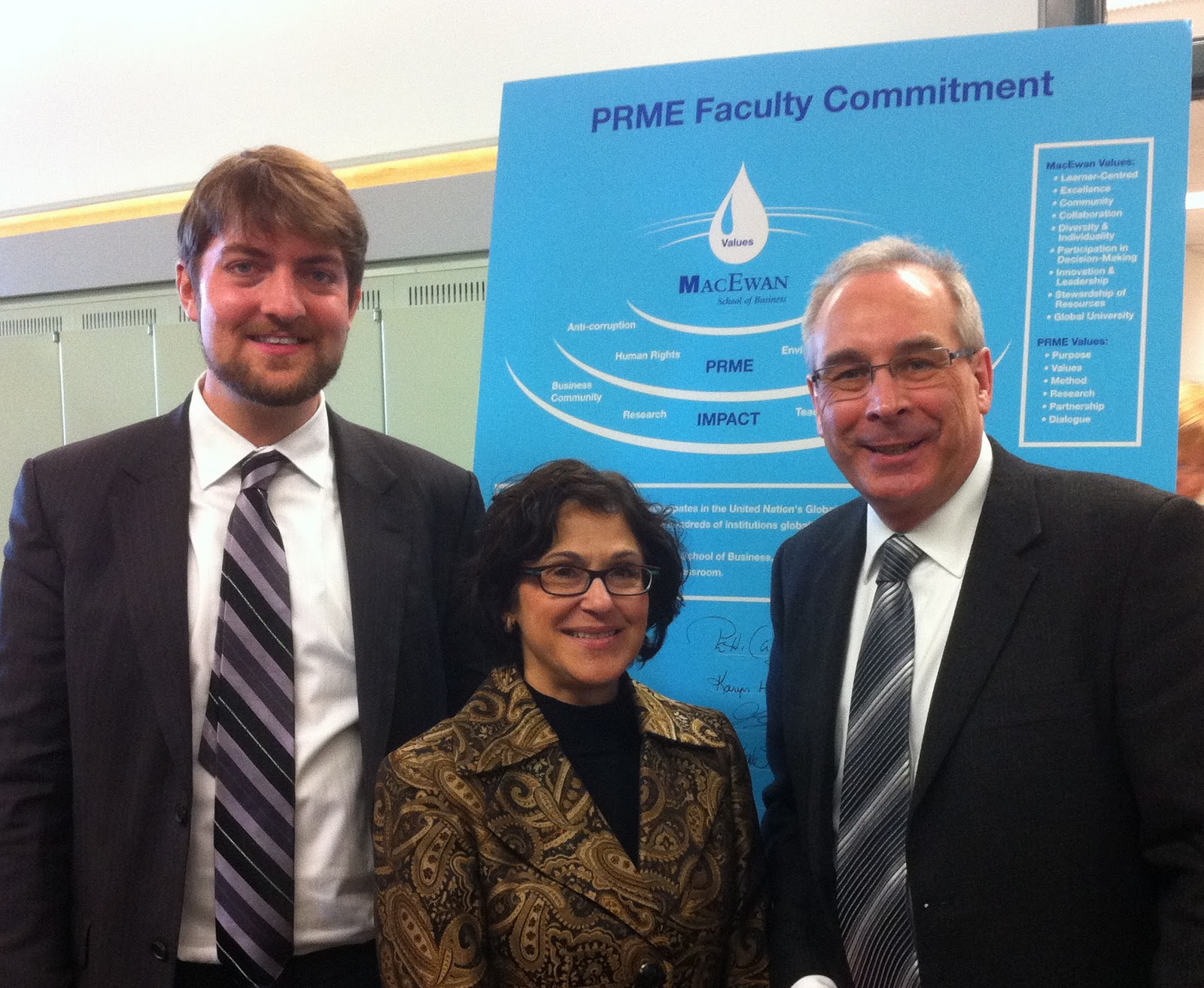
A Better Way to Business Success - PRME

Jonas Haertle, Elsie Elford & Jim Ewing


I enjoyed recently meeting Mr. Jonas Haertle, Head of the Principles for Responsible Management Education, (PRME) secretariat to the UN Global Compact Office.

Jonas was in Edmonton, Alberta for MacEwan University's, School of Business -  Global Awareness Week and the announcement of their signing on to PRME. With the official signing, MacEwan joins educational institutions and associations from around the world who are committed to achieving a more inclusive and sustainable global economy. You can find the PRME principles and more information regarding this initiative at: http://www.unprme.org/

While attending this event, I was also very pleased to have an extended conversation with Dean of MacEwan's School of Business, Elsie Elford. Thank you for your kind invitation to be with you and witness this significant event. Let me wish you, your colleagues and your many students the best of success in the future!

Question: What are your thoughts on the 6 principles that form the foundation of PRME? Are these reasonable expectations in a global economy - our shared 'global' village? What obligations, if any, should business have to the various stakeholders that they impact?

Click on the title for this Post to enjoy the video that MacEwan posted on YouTube ... and please add your comments here. Thanks

Saturday, January 22, 2011

How can a Business Plan help you Succeed?

You've likely heard the well known phrase: "Failing to Plan is Planning to Fail".  In fact, it's one that I've used many times over the past 15 years in the "Preparing Your Business Plan" Learning Session that I've presented at The Business Link Business Service Centre.  One thing that I mention to my audience is that even if you were to develop the best business plan possible, there is still no guarantee of having a successful business venture. 


Why is that? One reason is that things will very likely have changed from the time that you prepared your business plan, to the time of its implementation. Having said that, I still believe that your chances of success are significantly improved by developing and following a solid business plan.


If you would like to view a short video clip of what goes into a business plan, please take a look at the video that I did for The Business Link a few years ago. Simply click on the video clip icon with my picture, which can be seen at: www.canadabusiness.ab.ca/start-up


ALSO:


* Plan to attend the next "Preparing Your Business Plan" session if you can. Check for details and the complete schedule at:    www.canadabusiness.ab.ca/sessions )


* Be sure to search for additional resources related to, "Business Plans" on The Business Link's website at:     www.canadabusiness.ab.ca

Tuesday, December 07, 2010

Key Success Factor - "Mentorship"

We are very excited about the new video clips being added to our companion site: ProVision - Exploring Mentorship BLOG. 


Because MENTORSHIP can add such great value to the development of a business owner and contribute to their ultimate success, we've added this special post, and the first of several video clips that will highlight Mentorship, a significant Key Success Factor for business!


Be sure to further explore the valuable information on our Mentorship Site located at:     http://provision-mentorship.blogspot.com/   

Best wishes to you in the success of your business venture!

Sunday, November 21, 2010

What is Business Success?

That's a great question! What does Business Success mean to you?  Is there a connection to personal success, and if so, how would you describe that connection?  (Also, take a look at the other areas of our BLOG.)

I recently came across an interesting anecdote related to business success and success in life. It was found in the book, “Business ethics: ethical decision making and cases”, by O. C. Ferrell, John Fraedrich, Linda Ferrell. (Cengage Learning, 2006)

From one of the many case studies mentioned in this resource, the relationship between financial wealth and success is questioned. On page 150 there is an interesting analysis that challenges the validity of this commonly held assumption.

In 1923, nine of the wealthiest men of the day met at the Edgewater Beach Hotel in Chicago. The attendees included:
  1. Charles Schwab, president of the largest steel company in America.
  2. Samuel Insull, president of the largest utility company.
  3. Howard Hopson, president of the largest gas company.
  4. Arthur Cutten, the great wheat speculator.
  5. Richard Whitney, president of the New York Stock Exchange.
  6. Albert Fall, Secretary of Interior in President Harding’s cabinet.
  7. Jessie Livermore, the great “bear” on Wall Street.
  8. Ivan Kreuger, head of the world’s greatest monopoly.
  9. Leon Fraser, president of the Bank of International Settlements.

Twenty-five Years Later:
􏰁􏰁 Charles Schwab, died following five years of living off of borrowed money.
􏰁􏰁 Samuel Insull, died as a penniless fugitive from justice.
􏰁􏰁 Howard Hopson had gone insane.
􏰁􏰁 Arthur Cutten, had died bankrupt.
􏰁􏰁 Richard Whitney had been recently released from prison.
􏰁􏰁 Albert Fall had just been pardoned from prison to allow him to die at home.
􏰁􏰁 Leon Fraser, Jessie Livermore, and Ivan Kreuger had each committed suicide.

If success were to be measured by the level of wealth and power that one may exercise, these individuals had reached the apex of success. Unfortunately, the outcome of their lives falls significantly short of that which would be viewed as being successful. Clearly, money, in and of itself does not buy happiness.

So ... "What is Business Success and is there a connection to Personal Success?"

What are your thoughts? Thanks for your comments!


Monday, October 11, 2010

Your Invitation to Participate

The immediate challenge we have is in gathering the first hand experiences, original stories, tips, suggestions and the "lessons learned" from a variety of business owners and professionals who have either had a business of their own or helped their clients realize the "entrepreneurial dream."

All contributions that make it into the "published" edition will be fully acknowledged with appropriate reference back to their source. Participation in this project will not only provide early stage entrepreneurs with valuable resources to help them succeed, but it will also provide those who participate with valuable future exposure.

We are looking for your personal business experiences rather than a description of something that you have heard about from another source. A variety of formats are available and each has been further described in the various "posts" you see on this blog site.

We welcome your proposed contributions by posting to this BLOG. (Please do not send attachments or photos at this time.) Updates will also be posted by us from time to time to highlight samples of content received!

1) Words of Wisdom

1) Words of Wisdom: ( Approximately 50 - 75 words)

Have you benefitted from a great business saying that has stood the test of time? Perhaps you've come up with your own rendition of that saying and made it more meaningful for today. Why not put that saying into your own words now!

Here's your opportunity to put a new spin on some of those age old classics of business wisdom. For example: Old saying: "You can't sell from an empty wagon." New spin: "Empty store shelves won't satisfy anyone." ( We are very confident that you can do much better than that!)

2) Quick Tips

2) Quick Tips: ( Approximately 75 - 100 words)

Every business owner has appreciated a timely tip from someone, and has likely offered up a few great tips of their own over the years. Now it's time to collect those great suggestions and put them all into one place. Let's BLOG them! So to help us out, please identify - "WHAT" the suggestion is and a few bullet points on "HOW" it will improve results for those businesses that act on them.

Thank you to Canadian author Frances McGuckin for these great tips for business, from her National Best Selling book Business for Beginners.

GET PROFESSIONAL ADVICE: Enlist a consultant or accountant’s help in compiling the information into the correct format, and have him or her review it after both the first and final drafts. Putting it all together can be challenging. A bank would prefer to see that you have involved a professional—it helps to validate the contents.

KNOW YOUR GOALS AND OBJECTIVES: By knowing why you are preparing this plan, you can save time and effort by focussing on the important areas. Business plans often contain "filler" information that is not pertinent. Look at sample plans ... to get an idea. If you need to borrow funds, ask the lending institution exactly what is required.

COVER ALL BASES: Lenders look for sound managerial experience in the key areas of sales and marketing, accounting and technical operations. A gap in any one area will count as a strike against the business. Ensure you have covered all these bases in your plan. Competent managers are a strong indication that the business will be in good hands.

Used with permission of the author.
For more information regarding Frances McGuckin visit her Website at: http://www.smallbizpro.com/

3) Top Ten Things

3) Top Ten Things: ( Approximately 100 - 200 words)

Please indicate the topic for which you are providing content. For any of the suggested lists below, please identify - "WHAT" you recommend and then a few points related to "WHY" it is important and a few suggestions as to "HOW" it might be done.
- to succeed in business
- to face your competition
- to succeed in a global marketplace
- to improve cash flow
- to manage inventory
- to maximize profitability
- to find and retain great staff
- to improve working environment and relationships
- to master technology
- to deliver excellent customer service
- to improve efficiency
- to increase sales
- to better networking

DO YOU HAVE ANY OTHER SUGGESTIONS FOR A TOP TEN LIST? (Add your post!)

Thank you to Canadian author Frances McGuckin for this list, found in her National Best Selling book Business for Beginners.

TEN TIPS FOR BORROWING
1. Don’t approach a lender for "working capital." Loans are usually given for tangible assets that can be secured.
2. Don’t expect a lender to finance your whole venture. The owner is expected to invest money, at least one-third of the start-up cost.
3. When you call for an appointment, ask what information will be needed so you are well prepared.
4. Dress smartly. Jeans and sneakers are out. Don’t chew gum.
5. Research the various government-funded grants and loans before deciding on a lender.
6. Have an experienced third party critique your business plan before presenting it to a lender. 7. Have the approval of your spouse or partner before committing to financial obligations.
8. If you are initially turned down, take the lender’s advice and rework your plan.
9. Discuss with your accountant whom you should approach for money and what type of loan may best suit your requirements.
10. In your interview, be a good listener. Don’t try to hold the floor and convince the lender how great you are. He or she can tell this by your manner, presentation and business plan. Used with permission of the author.

For more information regarding Frances McGuckin visit her Website at: www.smallbizpro.com

4) Brilliant Business Insights

4) Brilliant Business Insights: ( Approximately 150 - 250 words)

This section is where you can share any of those "eureka" moments, you know - when the light came on and you discovered something new that helped you in your business. Perhaps your experience will help someone else as you let them know about what helped you! If that's the case, please identify - "WHAT" you discovered, a few points related to "WHY" it is important and a few suggestions as to "HOW" it might be done.

This area is intended to facilitate discussion regarding the process involved in uncovering / discovering new opportunities, skills, trends, etc that helped you advance your business.

We welcome your contributions to this section adding a New Post to this Blog. (Please do not send attachments or photos at this time.)

We will also be posting updates from time to time to highlight samples of contributions that we have found!

5) Challenges Overcome

5) Challenges Overcome: ( Approximately 350 - 750 words.)

This section provides you with an opportunity to express your unique story, of facing and overcoming some of the biggest challenges that a growing business will confront on the road to success. There is more room for describing the background and nature of the business, the situation being faced, the options considered, the decision that was made, the process used and the outcome. You may also want to discuss any changes that you would now make if you were given the opportunity to face that challenge again.

We welcome your contributions to this section and encourage you to add them as a New Post to this Blog. (Please do not send attachments or photos at this time.)

Updates will also be posted by us from time to time to highlight other samples of contributions that we have discovered!